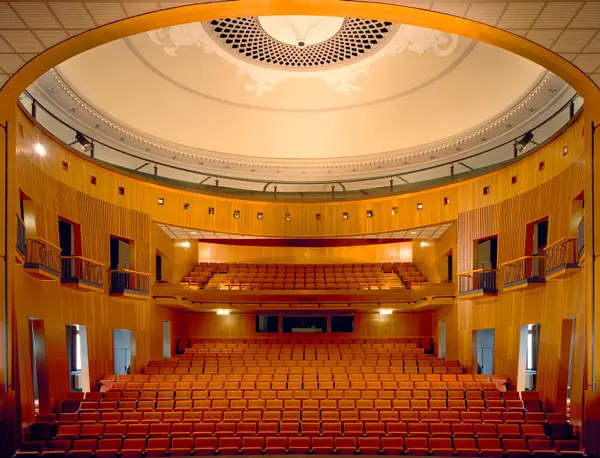
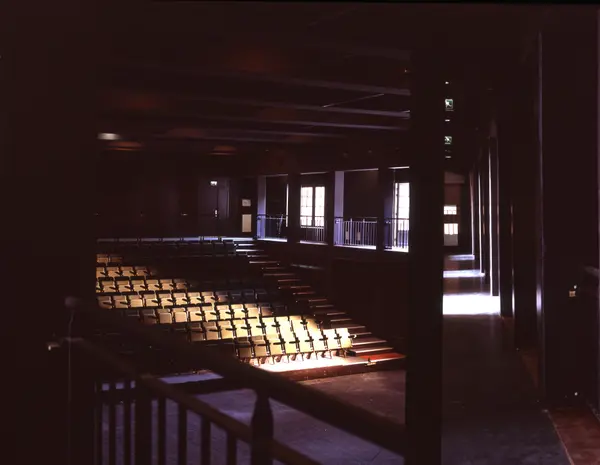
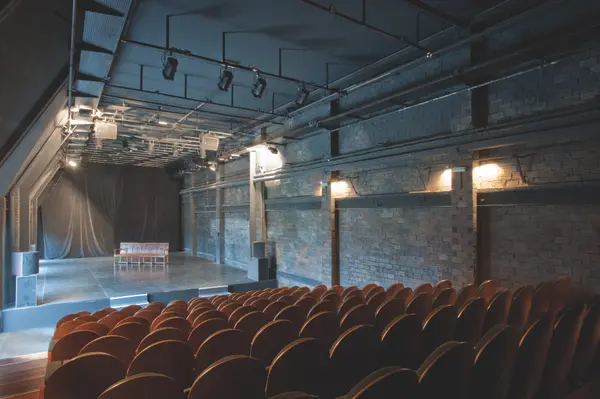
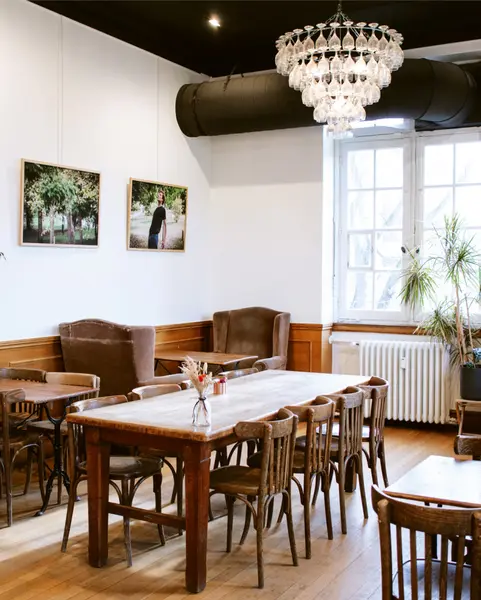
The history of the Théâtre de la Cité internationale is inextricably linked to that of the Cité internationale universitaire de Paris. When it was inaugurated in 1936 by President Albert Lebrun, in the presence of Jean Zay, it was part of a project conceived in the aftermath of World War I: to make encounters between peoples a prerequisite for peace. Located at the heart of the Maison internationale, the theater became one of the places where this ambition took shape.
From its earliest decades, it hosted performances by students from the Conservatoire as well as major Parisian theater companies. The Comédie-Française, the Odéon, and Jean Vilar’s TNP all presented their productions there. Gérard Philipe, Maria Casarès, and Jean-Louis Barrault performed before an audience of students from around the world. The theater was already establishing itself as a place for knowledge transmission, debate, and discovery.
A new chapter began in 1968 when, with the support of André Malraux, André-Louis Perinetti transformed the venue into a laboratory for contemporary creation. Amid the ferment following May 1968, the Théâtre de la Cité internationale became a true international crossroads where the artistic visions of the Bread and Puppet Theater, Eugenio Barba’s Odin Teatret, Antoine Vitez, Jorge Lavelli, and Jérôme Savary—who premiered the first productions of the Grand Magic Circus there—all came together. The theater thus kept pace with the aesthetic and political upheavals of its time, while Guy Caron carried this momentum forward by making the venue one of the major hubs of contemporary dance, notably by hosting Maguy Marin.
The next major turning point came in 1991 with the arrival of Nicole Gautier. Formerly the director of ONDA, she had deep knowledge of European creative networks and recognized, long before many others, the growing difficulty companies faced in gaining visibility in Paris. Her vision was simple yet ambitious: to make the Théâtre de la Cité internationale an essential stop for artists who were already making their mark on the contemporary scene but had not yet found their place in the capital.
For nearly twenty years, the TCI thus became one of the most valuable venues for French and European contemporary theater. It hosted productions by Didier-Georges Gabily, Jean-Luc Lagarce, Boris Charmatz, and Jean-Louis Martinelli; young directors destined to leave a lasting mark on European theater found their first home in Paris there. The theater was also one of the first in France to present Thomas Ostermeier, who was still relatively unknown outside of Germany at the time. Tg STAN’s Flemish troupe, the Argentine Rodrigo García, the New Yorker Richard Maxwell, and Josse De Pauw were all welcomed there at a pivotal moment in their careers. More than just a venue for performances, the TCI became a prime vantage point for observing the major shifts in European theater.
Under the direction of Pascale Henrot, the theater continued this openness by fostering cross-pollination between theater, dance, music, circus, and visual arts. Marc Le Glatin then strengthened support for emerging artists and forged closer ties with students, universities, and local residents, thereby reconnecting with the venue’s historic mission: to foster dialogue between artistic creation, youth, and intellectual life. In 2025, Frédérique Aït-Touati and Nathalie Vimeux were appointed to lead the theater.
For nearly ninety years, the Théâtre de la Cité internationale has remained true to the same vision: to provide a place where artists, students, researchers, and audiences from around the world can come together. A theater that has never ceased to be both a stage for creativity and a space for the exchange of ideas.